“I don’t know if I’m spending too much or too little — nobody gives a straight answer.”
If that sentence sounds familiar, you’re not alone. It’s the single most common question small business owners ask before they ask anything else about marketing: how much should a small business spend on marketing? And almost every answer online is the same unhelpful percentage, thrown out without context for your revenue, your stage, or what you’re actually trying to achieve.
This guide fixes that. Below, you’ll find a small business marketing budget framework built around real business stages — startup, two years in, and scaling — with actual dollar ranges you can apply this week, not abstract percentages you have to do math on.
Table of Contents
Why Nobody Gives You a Straight Answer
What the 2026 Data Actually Says
The Real Problem: Most Small Businesses Are Underspending, Not Overspending
A Marketing Budget Framework by Business Stage
- Stage 1: Startup (Year 0–1)
- Stage 2: Established (2+ Years In)
- Stage 3: Scaling (Aggressive Growth Targets)
Where the Money Should Actually Go
Common Budgeting Mistakes to Avoid
How Gyaata Helps You Get This Right
Why Nobody Gives You a Straight Answer
Ask five marketers “how much should I spend on marketing?” and you’ll get five different percentages — 5%, 8%, 12%, 20%. None of them are wrong, exactly. They’re just answering different questions.
A one-year-old startup trying to build awareness from zero has completely different needs than a firm that’s been operating for a decade with a loyal client base. Industry matters too — a consumer product business typically needs to spend far more of its revenue on marketing than a quiet B2B service firm. So when a blog post gives you one flat percentage, it’s rarely built for your business.
The fix isn’t a single magic number. It’s understanding where your business sits today, and applying a range that fits that stage — which is exactly what the framework in this guide is built around.
What the 2026 Data Actually Says
Before getting into stage-by-stage numbers, it helps to see where the industry benchmarks actually land:
- The U.S. Small Business Administration recommends businesses under $5 million in revenue allocate 7–8% of gross revenue to marketing.
- Businesses in their first two years, especially in competitive markets, often need to invest 12–20% of revenue just to build initial visibility.
- According to Crestmont Capital’s 2026 marketing spend benchmarks, B2C companies typically spend 9–12% of revenue on marketing, while B2B companies spend closer to 6–7%.
- Company size matters more than most owners realize — RevenueMemo’s 2026 small business marketing analysis found that businesses under $10 million in revenue allocate an average of 15.6% of their overall budget to marketing, a share that shrinks as the company grows and brand recognition compounds.
These are the guardrails. The next section explains why most small businesses aren’t anywhere close to them.
The Real Problem: Most Small Businesses Are Underspending, Not Overspending
Here’s the part that surprises most owners: the anxiety around “am I spending too much?” is usually pointed in the wrong direction. The data shows most small businesses are dramatically under-investing in the channels that deliver the best returns.
- 60% of small businesses are not currently investing in search advertising at all, according to PPC Chief’s 2026 PPC statistics report — even though paid search remains one of the most measurable, highest-intent channels available.
- 61% of small businesses are not investing in SEO, per WordStream’s 2026 SEO statistics roundup — despite SEO consistently ranking among the highest-ROI marketing channels for businesses of every size.
Put those two numbers together and the picture is clear: the majority of small businesses are sitting out the two channels most likely to bring in consistent, compounding leads. That’s not overspending. That’s leaving demand on the table for competitors to pick up.
If you’ve been holding back on search advertising or SEO because you weren’t sure it was “worth it,” the data suggests the opposite risk is far more common — and far more costly.
A Marketing Budget Framework by Business Stage
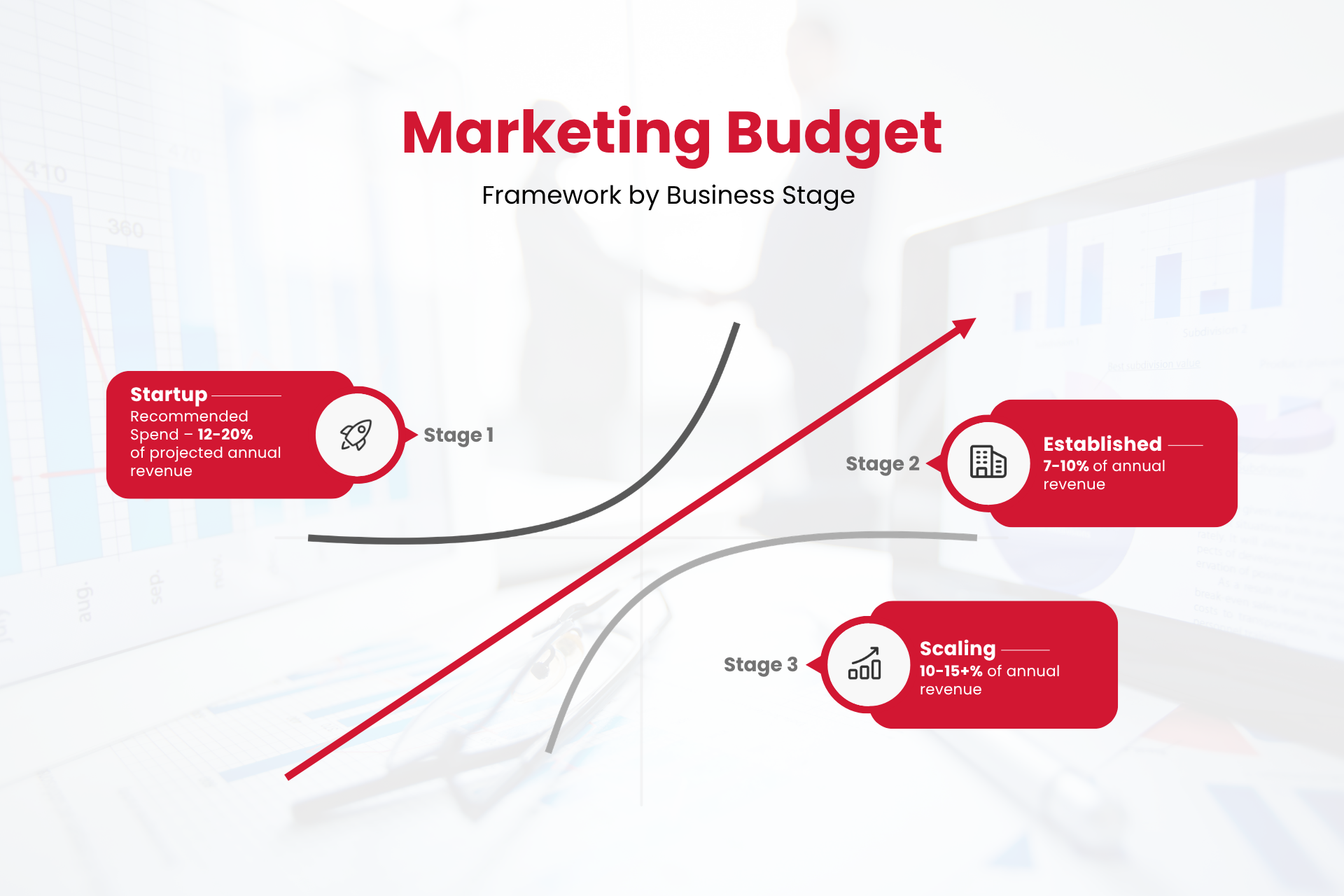
Instead of one flat percentage, use the stage your business is actually in. Below are practical dollar ranges, not just abstract percentages, so you can apply this immediately.
Stage 1: Startup (Year 0–1)
You have no brand recognition yet, so your budget has to work harder to earn attention.
- Recommended spend: 12–20% of projected annual revenue
- Example: On $200,000–$500,000 in projected revenue, that’s roughly $24,000–$100,000/year (about $2,000–$8,300/month)
- Focus: Building a foundation — a strong website, initial SEO setup, and early paid search testing to learn what converts
Stage 2: Established (2+ Years In)
You have some traction, repeat customers, and data to work with. This is where the SBA’s benchmark applies most directly.
- Recommended spend: 7–10% of annual revenue
- Example: On $500,000–$2,000,000 in revenue, that’s roughly $35,000–$200,000/year (about $2,900–$16,600/month)
- Focus: Scaling what’s already working, investing seriously in SEO and search advertising, and building out content and email marketing
Stage 3: Scaling (Aggressive Growth Targets)
You’re actively trying to outpace competitors, enter new markets, or hit an aggressive revenue target.
- Recommended spend: 10–15%+ of annual revenue
- Example: On $2,000,000–$10,000,000 in revenue, that’s roughly $200,000–$1,500,000/year (about $16,600–$125,000/month)
- Focus: Multi-channel investment — paid search, SEO, paid social, and conversion optimization working together, with tighter ROI tracking across all of it
A quick gut check: if you’re spending well under 5% of revenue at any stage above, you’re likely in the “invisible in a competitive market” zone the data warns about. If you’re above 20%, it’s worth confirming the spend is tied to measurable results, not just channel volume.
Where the Money Should Actually Go
Given how many small businesses are skipping search advertising and SEO entirely, these two channels deserve first priority in most budgets — they combine measurable short-term results (search ads) with compounding long-term value (SEO). From there, digital marketing for startups and small businesses typically layers in content, email, and paid social once the foundation is generating consistent leads.
The goal isn’t to spread your budget across every possible channel. It’s to fund the two or three channels with the clearest path to ROI, and expand from there once you can prove what’s working.
Common Budgeting Mistakes to Avoid
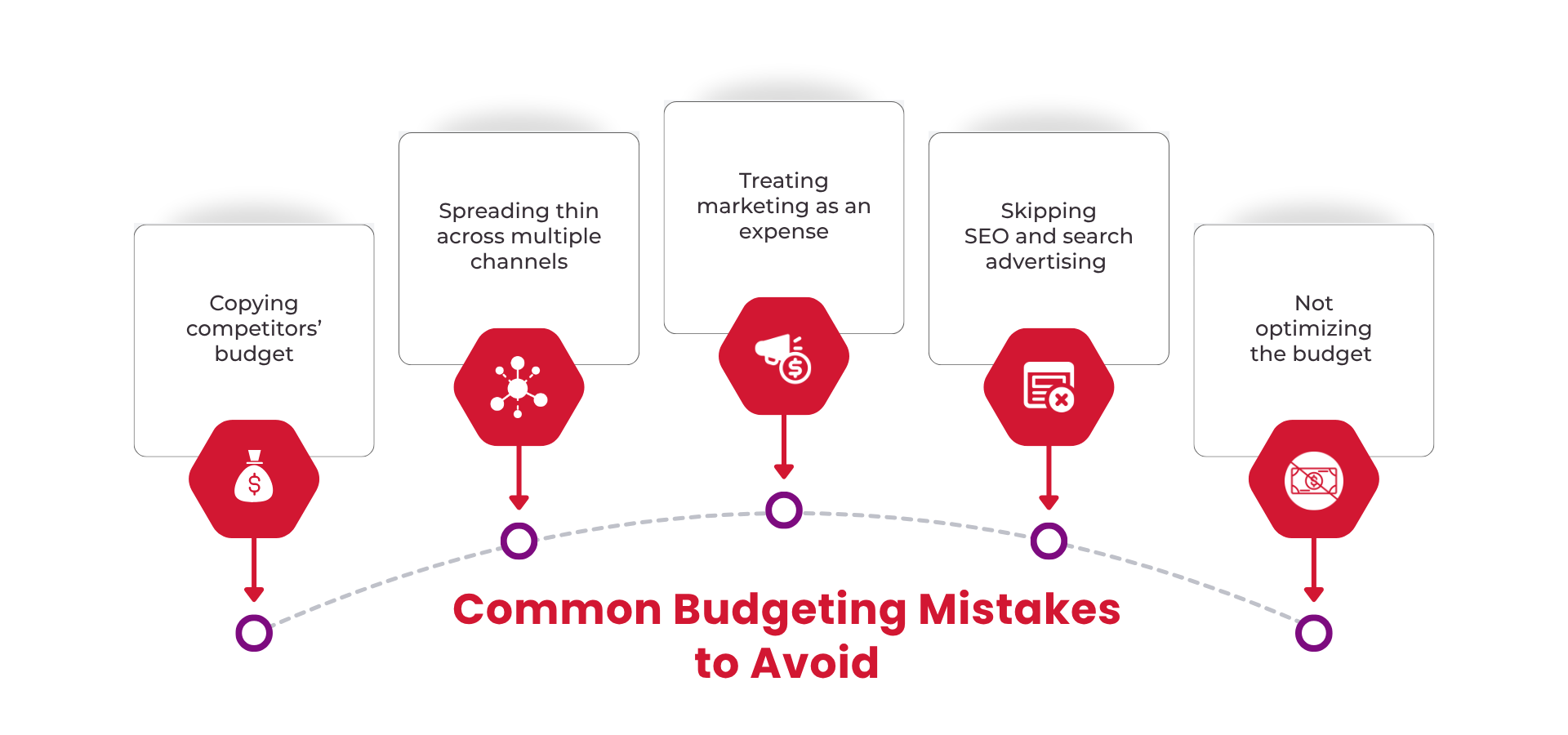
- Copying a competitor’s budget instead of basing it on your own stage and revenue
- Spreading too thin across six or more channels instead of going deep on two or three
- Treating marketing as an expense that gets cut first in a slow month, instead of a growth investment
- Skipping SEO and search advertising entirely because the ROI feels hard to measure upfront
- Never revisiting the number — your budget should shift as your business moves from one stage to the next
How Gyaata Helps You Get This Right
At Gyaata, we work with small and growing businesses every day who are asking exactly this question — and the honest answer is almost always specific to their stage, industry, and current channel mix, not a generic percentage. Our full range of marketing services is built to help you figure out where your budget is working, where it’s leaking, and which channels — SEO, search advertising, content, or social — deserve the next dollar.
Not sure if your current marketing spend is allocated correctly? Get a free 30-minute audit with our team — we’ll walk through exactly where your budget is going, what’s underperforming, and where the biggest opportunity is hiding.

FAQs
1. What percentage of revenue should a small business spend on marketing in 2026?
Most small businesses under $5 million in revenue should aim for 7–8% of gross revenue, per the U.S. Small Business Administration’s guidance. Newer businesses in competitive markets often need 12–20%, while businesses in aggressive growth mode may go higher.
2. Is the budget really different for a brand-new startup versus an established business?
Yes, significantly. A startup with no brand recognition has to spend more per lead to build visibility from scratch — often 12–20% of revenue. An established business with repeat customers and word-of-mouth can often operate closer to 7–8%, since it isn’t building awareness from zero.
3. What’s the biggest mistake small businesses make with their marketing budget?
Under-investing in the highest-ROI channels. With 60% of small businesses skipping search advertising and 61% skipping SEO entirely, the bigger risk for most businesses isn’t overspending — it’s leaving proven, measurable channels completely unfunded.
4. Should more of my budget go to SEO or paid search advertising?
Ideally, both — they work on different timelines. Search advertising delivers faster, more immediate leads, while SEO builds compounding, lower-cost traffic over time. A healthy small business budget typically funds both rather than choosing one over the other.
5. How do I know if my current marketing spend is being used effectively?
The clearest signal is whether you can trace spend to actual leads and revenue, not just impressions or followers. If you can’t confidently answer where your best customers are coming from, that’s usually a sign it’s time for an outside audit of your current allocation.