
Here’s an uncomfortable number to start with. The average website converts at just around 3%, according to 2026 industry benchmark data. That means 97 out of every 100 people who land on a typical service business website leave without becoming a lead. For business owners that’s a website problem, and usually one nobody’s looked at closely in years.
It’s an especially expensive problem for service businesses specifically clinics, consultancies, agencies, local providers, because the entire value of the website is the enquiry it generates. There’s no cart to recover, no browsing behaviour to remarket to. A visitor either fills out the form or they’re gone, often for good. Every leak in that journey is a lead that simply never existed.
So we decided to actually measure it. We audited 50 service business websites, spanning healthcare, professional services, home services, and B2B consultancies, looking specifically for what was quietly costing them conversions. We expected 50 different sets of problems, shaped by 50 different industries and design choices. Instead, we found the same seven mistakes showing up again and again, almost like a pattern baked into how most service websites get built in the first place.
Is Your Website Actually Costing You Customers?
If you’re a business owner asking this question, the honest answer is: probably, at least a little. Most service businesses don’t lose leads because their offer is weak or their pricing is wrong. They lose them because the website sitting between the ad click and the enquiry form quietly gets in the way. Slow pages, buried trust signals, and long forms don’t announce themselves. They just show up as a lower conversion rate nobody can quite explain, a marketing budget that seems to underperform, or a sales team complaining that “the leads just aren’t good lately.”
The frustrating part is that none of this shows up in a typical glance at the website. It looks fine. It has the services listed, a phone number, maybe a contact form. But “looks fine” and “converts well” are two entirely different standards, and most businesses have only ever been measured against the first one.
Why the Same Mistakes Keep Showing Up
Before getting into the list, it’s worth asking why these issues are so consistent across completely unrelated businesses. The pattern usually comes down to three things. First, most websites are built once and never revisited unless something breaks or looks visibly outdated. Second, many were designed primarily for aesthetics, by teams optimizing for how the site looks in a portfolio rather than how it performs with real traffic. Third, decisions about forms, CTAs, and page structure are often made internally, by whoever happens to be available, rather than being tested against actual visitor behaviour.
None of this is a knock on the businesses themselves. It’s simply what happens when a website is treated as a one-time project instead of an ongoing conversion tool. The seven mistakes below are the direct result.
How We Audited the 50 Websites
For each site, we ran the same checklist: mobile and desktop load speed, above-the-fold content, CTA visibility, form length and placement, trust signal positioning, and what happened immediately after a form was submitted. We treated each site the way a real visitor would, not as a technical exercise, which is exactly why the same practical, everyday issues kept surfacing instead of obscure technical bugs.
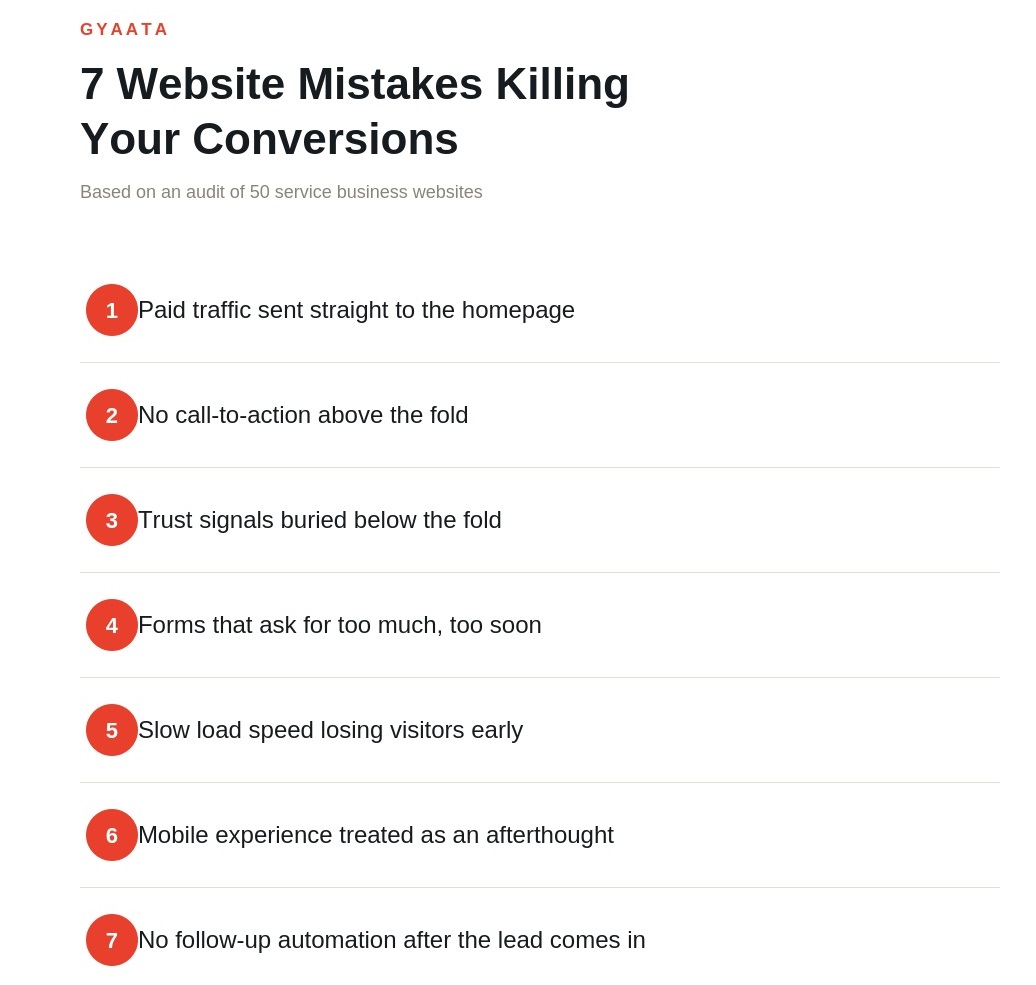
What We Found – The 7 Recurring Mistakes
Across all 50 sites, these seven issues showed up on the overwhelming majority, several appeared on more than 40 of the 50. None of them require a full rebuild to fix and all of them are quietly expensive to ignore.
1. Paid Traffic Sent Straight to the Homepage
Nearly every site running Google or Meta ads routed that traffic to a general homepage instead of a dedicated landing page matching the ad’s specific offer. A visitor who clicked an ad for “same-day plumbing repair” would land on a homepage covering ten different services, a company history section, and a generic contact form. Visitors arriving from a specific ad expect a specific answer and a homepage forces them to go hunting for it, and most simply won’t bother. This mismatch alone was likely the single most expensive mistake across the audit, since it affects paid traffic the business is actively paying for.
2. No Call-to-Action Above the Fold
On more than half the sites audited, visitors had to scroll past a hero image, a mission statement, or an image slider before finding any way to actually get in touch. Some sites buried their phone number in the footer entirely. If the first screen a visitor sees doesn’t tell them what to do next which is call, book, enquire, most won’t scroll far enough to find out how.
3. Trust Signals Buried Below the Fold
Testimonials, certifications, and client logos were almost always present somewhere on these sites, just placed too far down the page to matter. By the time a visitor scrolls far enough to see them, most have already made an unconscious decision about whether to trust the business or leave. Moving proof points higher on the page, even just a client logo strip near the top, consistently helps visitors decide to stay.
4. Forms That Ask for Too Much, Too Soon
Long, detailed forms were one of the most consistent issues across the audit. B2B research from Brixon Group found forms with more than five fields see roughly 30% lower conversion than shorter versions. Most of the sites we audited asked for six, seven, sometimes ten fields — company size, budget range, how they heard about the business, before a conversation happened. That’s information worth collecting eventually, just not before someone has agreed to talk to you at all.
5. Slow Load Speed Killing Conversions Before the Offer Is Seen
Speed came up as an issue on almost every site we audited. According to 2026 website speed benchmarks, pages loading in one second convert at close to 40%, dropping to roughly 29% by the three-second mark, and falling further from there. Several of the audited sites took five seconds or more to load on mobile networks. This time is well past the point where most visitors have already left. In practice, this means a business can have a perfect offer, a perfect ad, and a perfect landing page, and still lose the majority of visitors before a single word of copy is even read.
6. Mobile Experience Treated as an Afterthought
Mobile devices now account for roughly 72% of total website traffic, per 2026 conversion benchmark research, yet most of the audited sites were clearly designed desktop-first and adapted for mobile as an afterthought. Buttons were too small to tap accurately, forms required excessive zooming and scrolling sideways, and load times were consistently slower on mobile than desktop. This is a gap that according to 2026 speed research, causes over half of mobile users to abandon a site that takes more than three seconds to load. Given that mobile makes up the majority of traffic for most service businesses, this single issue compounds every other mistake on this list.
7. No Follow-Up Automation After the Lead Comes In
Even when a form was submitted successfully, most businesses had no automated next step in place. There was no confirmation email, no immediate follow-up trigger, nothing beyond a plain “thank you” page. In a handful of cases, we tested the form ourselves and received no response at all within 24 hours. Leads that go quiet for even a few hours are leads that start looking at competitors instead. Service businesses miss the fact that conversion completes only once someone actually responds.
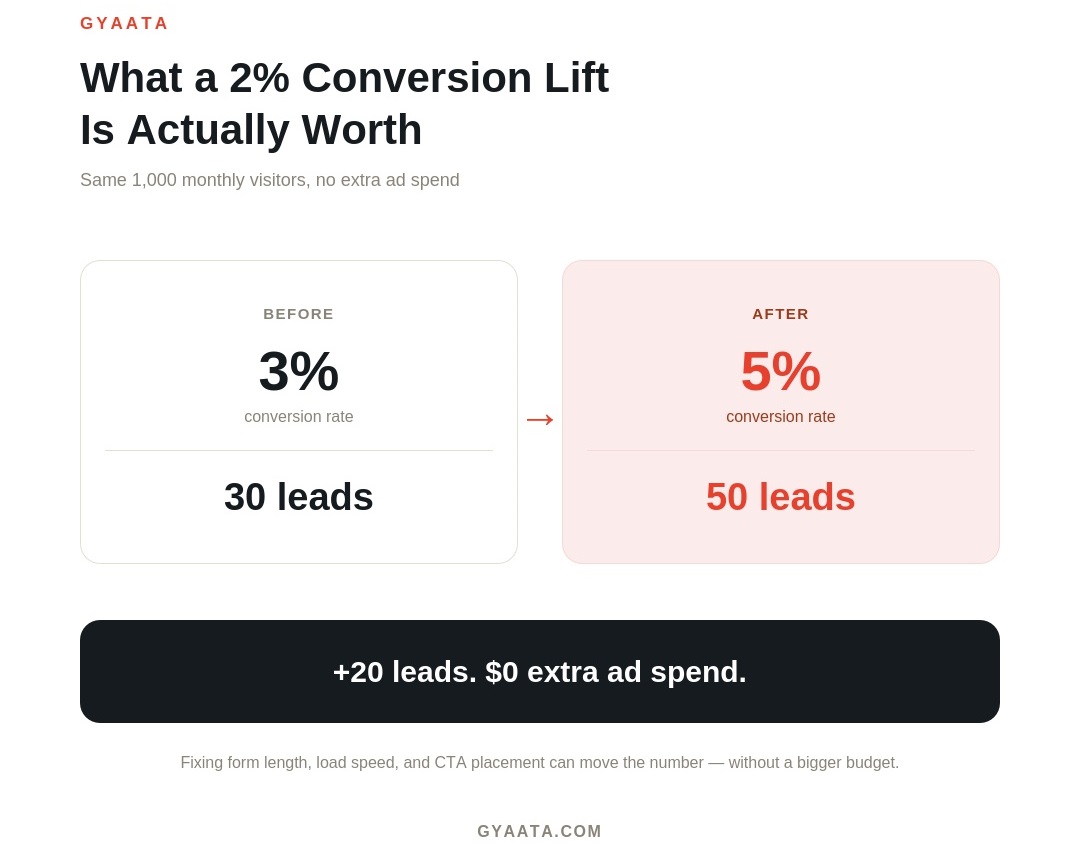
What Fixing These Mistakes Is Actually Worth
It’s easy to treat these as minor technical details, but the math adds up quickly. A business generating 1,000 monthly visitors at a 3% conversion rate gets 30 leads. Move that conversion rate to just 5%, a realistic outcome from fixing form length, load speed, and CTA placement alone and the same traffic produces 50 leads, without spending an extra rupee on advertising. For most service businesses, that’s not a marginal improvement; it’s the difference between a marketing budget that pays for itself and one that quietly underperforms every month.
Self-Audit Checklist – Is Your Website Making These Mistakes?
Run through this quickly against your own site. Most of these take less than two minutes to check:
- Does your paid traffic land on a dedicated page, or just the homepage?
- Can a visitor see a clear CTA without scrolling?
- Are testimonials or trust signals visible near the top of the page?
- Does your main enquiry form ask for more than 4-5 fields?
- Does your homepage load in under 3 seconds on mobile?
- Have you actually tested your site on a phone recently, not just looked at it?
- Does a submitted lead trigger any automatic follow-up at all?
If you answered “no” or “not sure” to more than two of these, your website is very likely costing you leads right now, whether or not it shows up anywhere in your reporting.
How Gyaata Fixes This
This is exactly the kind of audit Gyaata runs for service businesses. This is not a generic design review, but a conversion-focused breakdown of where a site is actually losing people. We look at page speed, CTA placement, form friction, mobile experience, and trust signal placement together, because fixing one in isolation rarely moves the number on its own. A faster page with a buried CTA still underperforms; a great CTA on a slow page still loses visitors before they ever see it.
Once we know where a site is leaking leads, the fixes are usually fast and surgical rather than a full teardown. That might mean restructuring a single landing page to match ad intent, trimming a form from eight fields to four, compressing image assets to cut load time in half, or setting up basic lead follow-up automation so no enquiry sits untouched overnight. None of it requires a full rebuild, most of the 50 sites we audited could meaningfully fix their single biggest issue in under two weeks.
If you want the same audit run on your own website, we’re offering it free. We will conduct a full review of your conversion rate, load speed, and CTA placement, with specific, actionable fixes you can act on immediately. You can request it directly, or read more breakdowns like this one on the Gyaata blog. If you’d rather explore our full approach first, take a look at our conversion rate optimization services.
Get Your Free Website Audit

Frequently Asked Questions
1. What is a good website conversion rate for a small service business?
Most websites convert around 3% on average, but lead-based service businesses with a well-optimized site can often reach 5-10% or higher, depending on the industry, offer, and traffic quality.
2. How much does page load speed really affect conversions?
Significantly. Sites loading in one second convert at nearly 40%, compared to roughly 29% at three seconds. This is a gap that compounds quickly as load time increases further, especially on mobile.
3. Should I shorten my website’s lead form?
In most cases, yes. Forms with more than five fields typically see about 30% lower conversion in B2B contexts. Ask only for what you need to start a conversation, and qualify further after the first contact.
4. Is mobile optimization really necessary for a service business website?
Yes, mobile now accounts for roughly 72% of website traffic, and more than half of mobile users abandon a site that takes over three seconds to load. A slow or clunky mobile experience directly costs leads.
5. How long does it take to fix these issues on an existing website?
Most of these fixes don’t require a full rebuild. Restructuring a landing page, shortening a form, or compressing assets for speed can typically be done within one to two weeks, depending on the platform the site is built on.
6. Do I need a full website redesign to improve conversions?
Usually not. Most conversion issues come from a handful of specific, fixable problems such as form length, load speed, CTA placement, rather than the overall design. A targeted audit is often more cost-effective than a full redesign.