Here’s something worth sitting with before you increase your ad spend: a completed Google Business Profile gets roughly seven times more clicks than an incomplete one, according to 2026 Google Business Profile research. That’s a free tool, fixed in an afternoon, producing a multiple most paid campaigns never reach.
This is the pattern behind almost every service business that generates leads consistently. They don’t outspend their competitors. They’ve just closed the gaps most businesses leave open, the free profile nobody finished, the happy customers nobody asked for referrals, the enquiries nobody followed up on. Budget helps, but it’s rarely the thing separating businesses that get leads from businesses that don’t.
Below are seven lead generation for service businesses strategies, ordered deliberately: free and low-cost first, paid last. Each includes a realistic cost and a realistic timeframe, because the honest answer to “how long until this works” matters as much as the tactic itself.
Why Don’t You Need a Big Budget to Generate Leads?
Because most lead generation failures aren’t spending failures, they’re system failures. A business with a modest budget and a tight process will reliably outperform a business with a large budget and a leaky one, for a simple reason: paid traffic amplifies whatever system it lands on. If enquiries go unanswered for two days, more ad spend just produces more unanswered enquiries.
The businesses generating leads consistently tend to have three things in place before they spend meaningfully on ads: they’re findable when someone searches, they have a repeatable way of turning happy customers into new ones, and they follow up fast enough to matter. None of those three require a large budget. All three require attention.
There’s also a sequencing problem worth naming. Most service businesses reach for paid advertising first because it feels like the most direct route to leads. The free strategies feel slower and less certain, so they get postponed indefinitely. But the free strategies are precisely what make paid advertising work when you eventually turn it on. Skipping them doesn’t save time; it just makes every future dollar of ad spend less effective than it should have been.
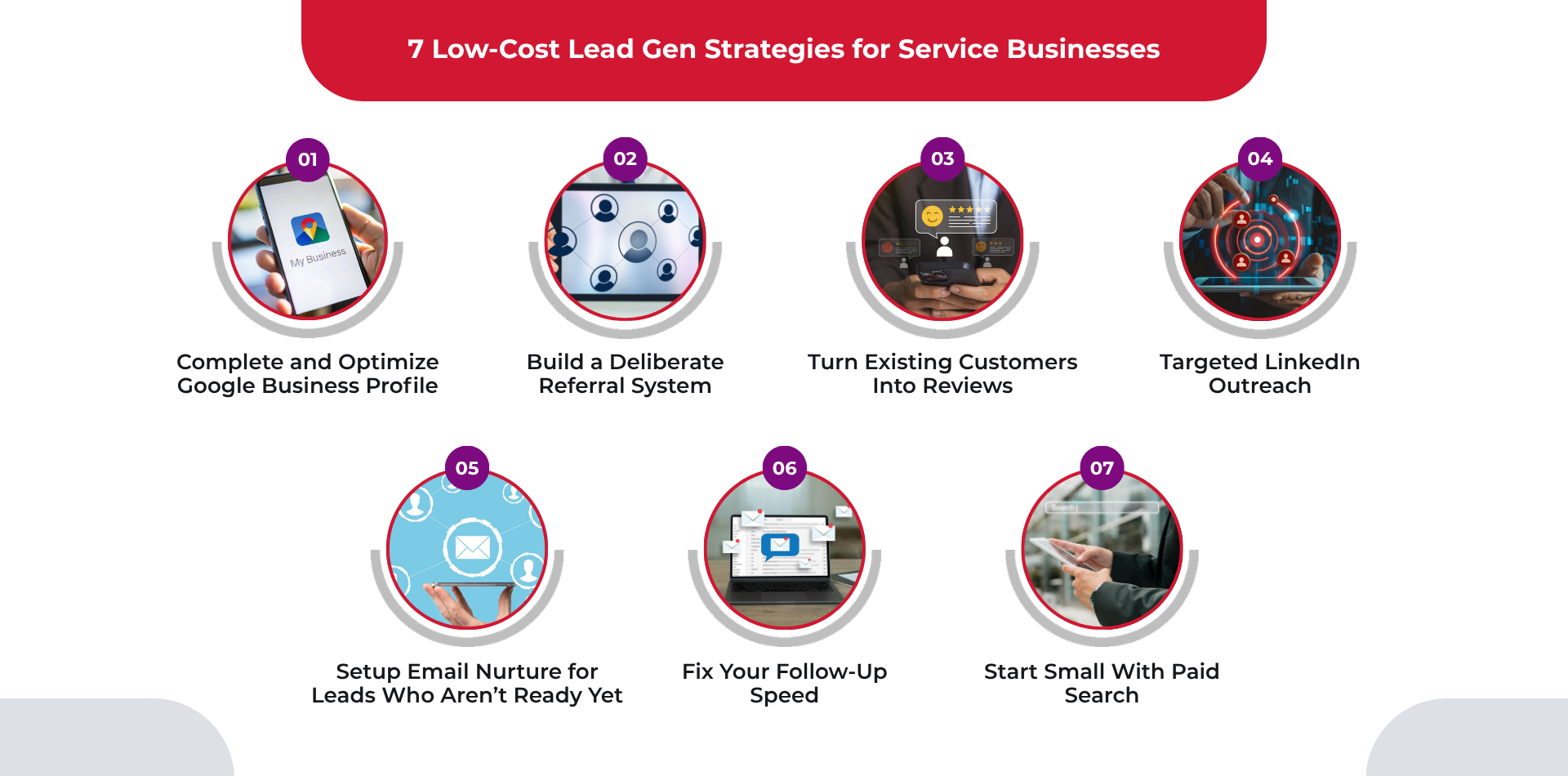
Strategy 1: Complete and Optimize Your Google Business Profile
Cost: Free | Timeframe: 2-6 weeks to see movement
For local service businesses, this is the highest-return action available, and it’s free. Around 42% of Google Business Profile conversions come from people who never visit the company website at all, and roughly 61% of high-performing profiles convert through calls, direction requests, or bookings rather than website clicks, per 2026 profile benchmark data. For many service businesses, the profile is the website as far as the customer is concerned.
What actually moves the needle here:
- Complete every field — 75% of businesses ranking in the top-3 local pack have a completed description section
- Get the primary category right — choosing the wrong one is the single most damaging local SEO mistake you can make
- Add a booking or appointment link — listings with one drive roughly 21% more conversion actions
- Post at least twice a month — profiles posting regularly appear in top-3 map results over three times more often
- Refresh photos every 90 days — stagnant listings see roughly 22% less engagement
What makes this strategy unusual is how much of it is a one-time fix. Completing your fields, choosing the right category, and adding a booking link are afternoon tasks that keep paying out for years. Only the posting and photo refreshes need ongoing attention, and even those take minutes rather than hours. For a local service business, there is genuinely no cheaper lever available.
Strategy 2: Build a Deliberate Referral System
Cost: Free to low | Timeframe: 1-3 months
Referral leads convert around 30% better than leads from any other channel, and referral programs generate 3-5x higher conversion rates than other marketing channels, according to 2026 referral marketing research. The gap between businesses that get referrals and those that don’t usually is that one group asks and the other assumes.
Roughly 83% of satisfied customers say they’re willing to refer a business, but only about 29% actually do. That gap is the entire opportunity. Sales reps who explicitly ask for referrals close around 35% more deals because most people simply never think to refer unless prompted at the right moment.
Make it systematic rather than occasional: ask at the point of highest satisfaction (project completion, a positive review, a thank-you email), make the ask specific rather than vague, and give people something easy to forward like a link, a short description, a name.
Specificity matters more than most businesses expect. “Let me know if you know anyone who needs us” puts the work on the customer and usually produces nothing. “If you know another clinic dealing with the same scheduling problem we fixed for you, I’d love an introduction” gives them a clear picture of who to think of. The first is a pleasantry; the second is an actual request someone can act on.
The payoff extends past the first sale. Referred customers show roughly 37% higher retention and at least 16% higher lifetime value than customers acquired through other channels, which means a referral system doesn’t just lower acquisition cost, it improves the quality of who you end up working with.
Strategy 3: Turn Existing Customers Into Reviews
Cost: Free | Timeframe: Ongoing, compounding
Reviews work as a conversion lever for service businesses with measurable returns. There’s roughly a 3% lift in Google Business Profile conversions for every 10 new reviews, and businesses that improve their rating from 3.5 to 3.7 stars can see conversion rates increase by nearly 120%, per 2026 local SEO statistics.
Businesses that respond to all their reviews achieve up to 18% more revenue and convert enquiries at roughly 50% better rates. The average business currently takes about 17 hours to respond to a review, which means simply responding faster than that puts you ahead of most competitors at zero cost.
The practical difficulty is volume, not strategy. Most service businesses have plenty of satisfied customers and very few reviews, for the same reason they have few referrals: nobody asks. The fix is to build the request into the moment work finishes, while the result is still fresh, rather than sending a generic request weeks later when the customer has moved on.
One thing worth knowing: reviews compound in a way most marketing doesn’t. Each one improves your local ranking, which increases profile views, which produces more customers, some of whom leave reviews. It’s slow at first and then noticeably faster — which is exactly why starting now matters more than starting perfectly.
Strategy 4: Targeted LinkedIn Outreach (For B2B Service Businesses)
Cost: Free to low | Timeframe: 4-8 weeks
For service businesses selling to other businesses, LinkedIn outreach remains one of the few channels where effort substitutes almost perfectly for budget. The catch is that it only works when it’s genuinely targeted. 20 well-researched, personalized messages on LinkedIn consistently outperform 500 templated ones, and the templated approach actively damages your reputation while it fails.
A realistic approach for a business with no budget:
- Define a narrow ideal customer — industry, company size, role, and a specific problem you solve for them
- Engage before you pitch — comment meaningfully on their posts for a week or two first
- Lead with a specific observation — reference something real about their business, not a generic compliment
- Ask for a conversation, not a sale — the first message should have a very low bar for saying yes
- Follow up twice, then stop — persistence works; pestering doesn’t
Strategy 5: Set Up Email Nurture for Leads Who Aren’t Ready Yet
Cost: Low | Timeframe: 2-4 months
Email consistently produces the highest return of any digital channel, at roughly $36-45 for every $1 spent, and drives a 4.24% conversion rate compared to 0.59% for social media, according to 2026 email marketing benchmarks. For service businesses specifically, its real value is patience: most enquiries aren’t ready to buy immediately, and email is the only channel cheap enough to stay in touch for months without burning budget.
This doesn’t require a sophisticated setup. A welcome email, three or four genuinely useful follow-ups spaced over a few weeks, and a simple monthly note will outperform most businesses in this category, largely because most service businesses send nothing at all after the first reply.
The content matters less than the consistency. Emails that answer a question your customers actually ask, explain something they’d otherwise have to research, or share what you learned solving a similar problem will keep people reading. Emails that only announce offers will not. The goal is to still be a familiar name when the timing finally becomes right for them, which might be next month or next year.
Strategy 6: Fix Your Follow-Up Speed
Cost: Free | Timeframe: Immediate
This strategy is more about lead preservation, and it’s the cheapest item on this list. Businesses that answer messages within 24 hours see roughly 50% better enquiry-to-sale conversion rates. Every hour an enquiry sits unanswered, the odds shift toward whichever competitor replied first.
Practical fixes that cost nothing: enable messaging on your Google Business Profile (businesses with it enabled receive roughly 35% more leads), set up a simple auto-reply confirming receipt and setting expectations, and give someone clear ownership of responding. Most service businesses lose more leads at this step than at any other, and it’s the easiest one to fix.
Strategy 7: Start Small With Paid Search Only After the Above 6 are Working
Cost: Moderate | Timeframe: 2-8 weeks
Paid comes last deliberately. Ads amplify an existing system rather than replacing one and if strategies one through six aren’t in place, paid traffic lands on the same gaps that were already losing leads, just at higher volume and cost.
When you are ready, start narrow rather than broad: a small budget on high-intent search terms (the ones where someone is actively looking to hire, not just researching), pointed at a dedicated landing page rather than your homepage. Track cost per lead from week one, and resist scaling until that number holds steady. A tightly-run small budget beats a loosely-run large one more often than most businesses expect.
How Do You Know If Any of This Is Working?
Low-budget lead generation fails more often from poor measurement than poor tactics. Without tracking, it’s impossible to tell which of the seven strategies is producing results and which is quietly consuming time for nothing. So, businesses either abandon strategies that were about to work, or keep pouring effort into ones that never will.
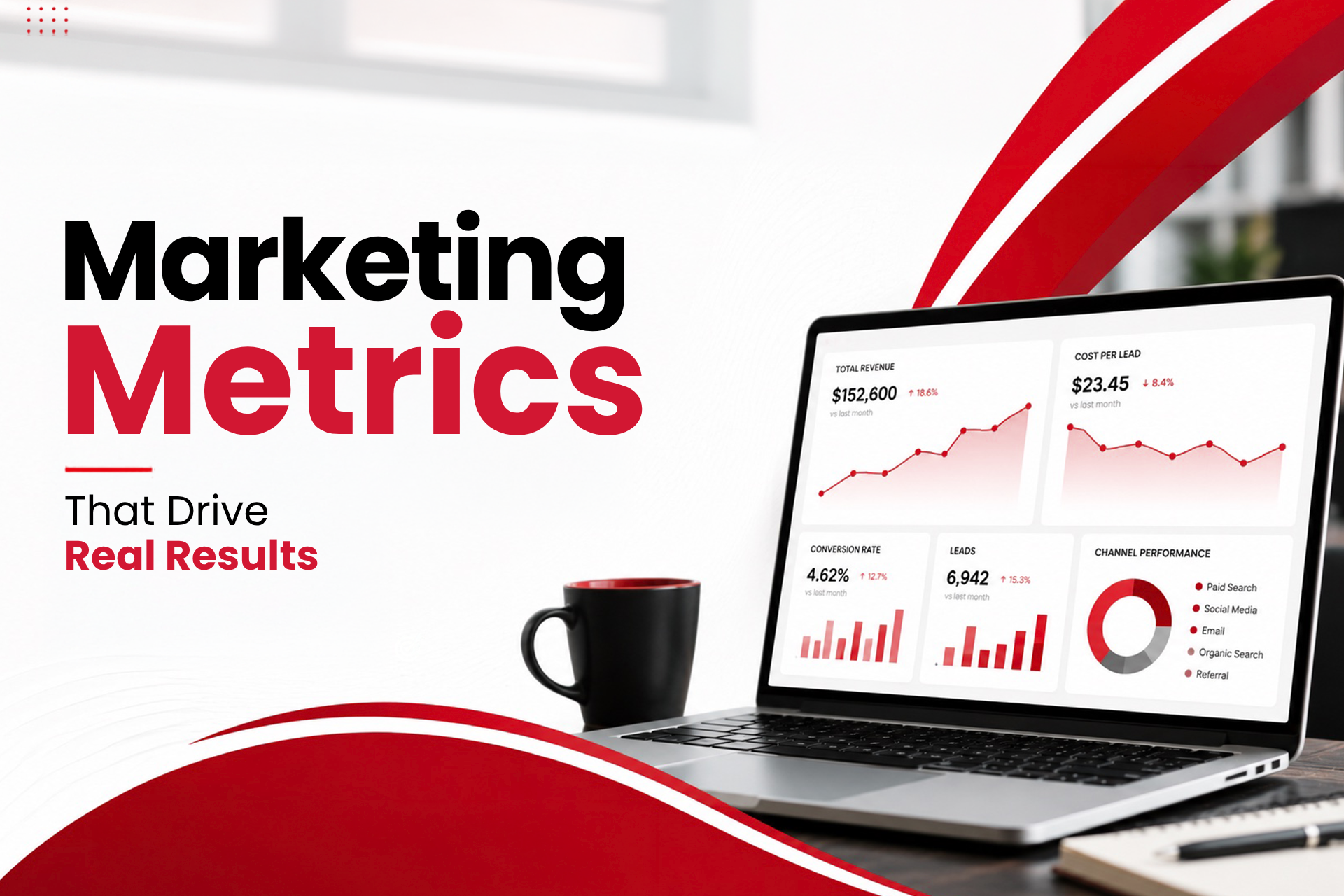
You don’t need sophisticated analytics. Four numbers, checked monthly, cover most of it:
- Where each lead came from — ask every enquiry how they found you, and write it down
- Cost per lead by channel — including your time, valued honestly, not just money spent
- Time to first response — the single metric most correlated with conversion for service businesses
- Lead-to-customer rate by source — referral leads and paid leads rarely convert at the same rate, and averaging them hides that
That last one matters more than it appears. A channel producing fewer leads that convert at triple the rate is outperforming a channel producing volume that never closes — but a business tracking only total lead count will reach the opposite conclusion and defund the better channel.
Which Strategy Should You Start With?
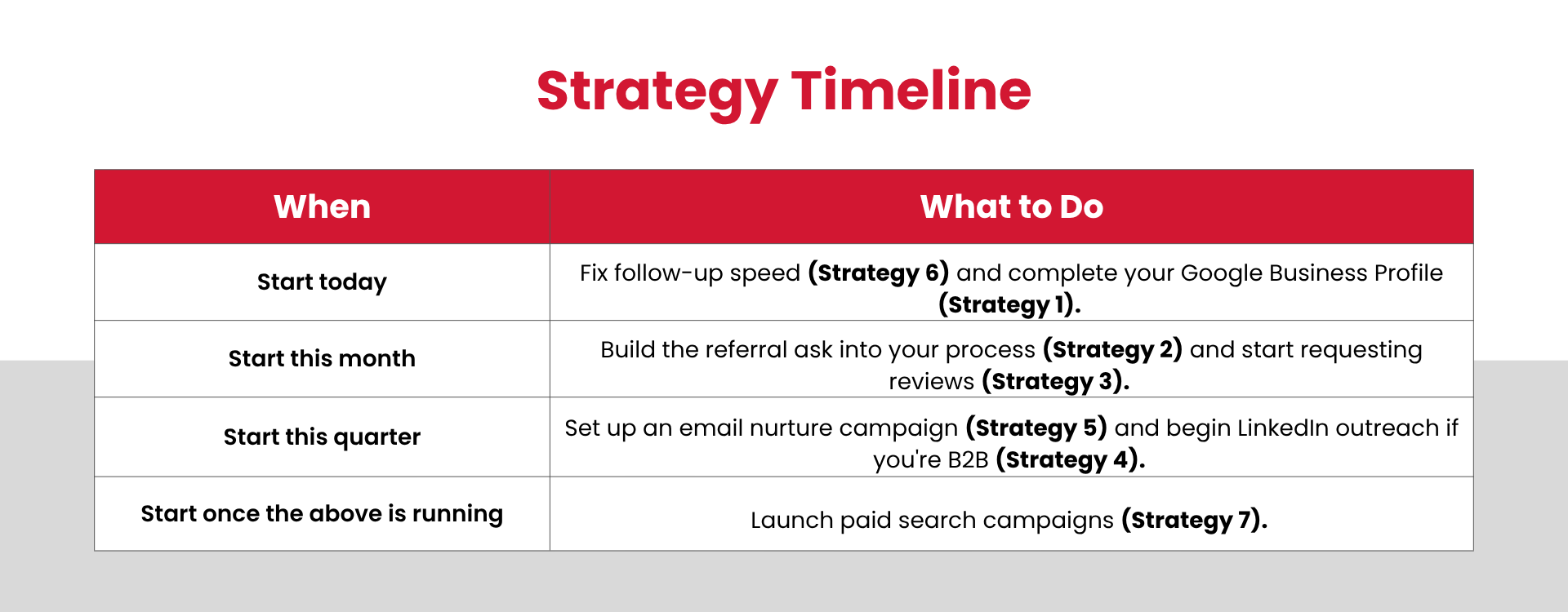
If you’re choosing where to begin, sequence matters more than volume:
- Start today — fix follow-up speed (Strategy 6) and complete your Google Business Profile (Strategy 1)
- Start this month — build the referral ask into your process (Strategy 2) and start requesting reviews (Strategy 3)
- Start this quarter — set up email nurture (Strategy 5), and LinkedIn outreach if you’re B2B (Strategy 4)
- Start once the above is running — paid search (Strategy 7)
Most service businesses attempting all seven at once complete none of them. Two done properly will outperform seven done halfway.
How Gyaata Helps Service Businesses Generate More Leads
At Gyaata, we work with service businesses on exactly this problem by finding which of these seven strategies are missing, incomplete, or quietly leaking leads. In most audits we run, the biggest wins come from the free strategies rather than the paid ones, simply because those are the ones businesses assume are already handled.
The pattern repeats: a half-finished Google Business Profile, referrals left entirely to chance, and enquiries sitting unanswered overnight. Fixing those three alone often changes a business’s lead volume before a single rupee goes into advertising. We’ve written more on the website side of this problem in our breakdown of the 7 conversion mistakes we found auditing 50 service business websites, and you can find more practical guides on the Gyaata blog.
Get a Free Lead Generation Audit

Frequently Asked Questions
1. What is the cheapest way to generate leads for a service business?
Completing and optimizing your Google Business Profile is the cheapest high-impact option, it’s free, and completed profiles receive roughly seven times more clicks than incomplete ones. Building a referral ask into your existing customer process costs nothing and delivers the highest-converting leads.
2. How long does it take to see results from low-budget lead generation?
It varies by strategy. Follow-up speed improvements show results immediately, Google Business Profile optimization typically takes 2-6 weeks, referral systems take 1-3 months, and email nurture generally takes 2-4 months to mature.
3. Do I need paid ads to generate leads consistently?
No. Many service businesses generate consistent leads without paid advertising, primarily through local search visibility, referrals, and reviews. Paid ads amplify an existing system — they work best once the free strategies are already in place.
4. How many reviews does a service business need?
There’s no fixed number, but businesses ranking in top local positions average well over 200 reviews, and each additional 10 reviews correlates with roughly a 3% lift in profile conversions. Consistency matters more than hitting a specific total.
5. Is LinkedIn outreach worth it for small service businesses?
For B2B service businesses, yes — it’s one of the few channels where careful targeting substitutes for budget. It’s generally not worth the effort for businesses serving consumers rather than other businesses.
6. What’s the most common lead generation mistake service businesses make?
Slow follow-up. Businesses responding to enquiries within 24 hours see roughly 50% better conversion rates, yet many service businesses take longer, losing leads they’ve already paid to generate.