There is a frustrating stage many small businesses reach: the business is good, the customers are real, the marketing is active but the brand still feels forgettable. The website looks fine. Social media is being posted. The logo is perfectly usable. Yet when you ask, “What would a customer remember about us?” the answer is often unclear.
That does not automatically mean you need a new logo, new colours, or an expensive rebrand. Often, the problem is the lack of alignment between the elements you already have.
A strong brand is built through connected signals: visual identity, positioning, voice, proof and differentiation. If those signals are inconsistent or generic, your audience has to work too hard to understand and remember you. Current branding guidance from HubSpot similarly treats branding as more than a logo, covering positioning, purpose, personality, values, voice, visual identity and customer interactions.
Before You Redesign – Diagnose the Brand
Think of branding as a system rather than a single design project. Gyaata’s branding services cover identity, logo, tagline, brand voice, positioning, website and offline collateral because memorability comes from how these pieces work together, not from one visual asset alone.
The five checks below are designed as a first-pass diagnostic. You can run them yourself before spending money on a full identity overhaul.
The 5-Step Brand Clarity Fix
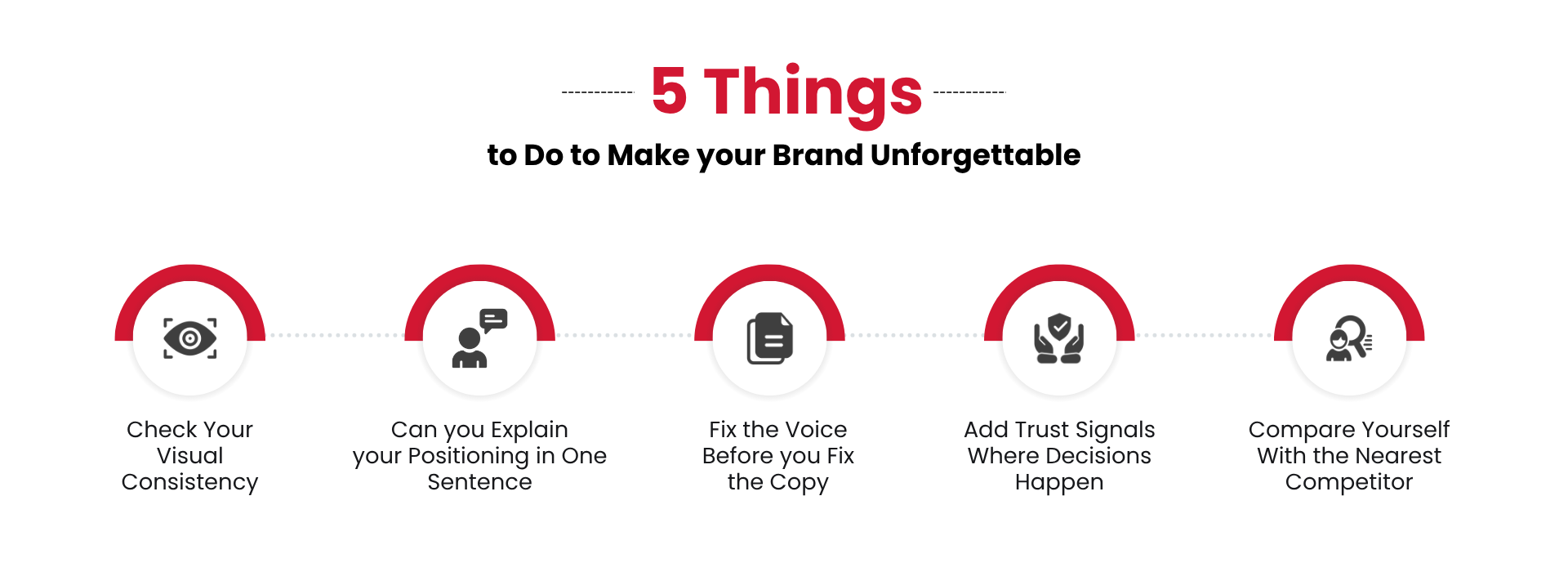
1. Check Your Visual Consistency
Start with five customer-facing places: your website homepage, Instagram or LinkedIn, sales presentation, proposal or brochure, and email signature. Put them side by side. Do they look like they came from the same business?
Look beyond the logo. Check colours, typography, image style, graphic treatment, spacing and recurring design elements. You do not need a sophisticated brand guideline document to start. A one-page reference showing approved colours, fonts, logo usage, image direction and examples can remove a surprising amount of inconsistency.
If the visual side needs a focused review rather than a complete redesign, Gyaata’s guide on creating a timeless brand identity with a strong logo is a useful reference.
The goal is not perfection, it is recognition. A customer should not have to mentally reconnect your website, social profile and sales material every time they encounter you.
2. Can You Explain Your Positioning in One Sentence?
If your answer is “We provide high-quality solutions for businesses” or “We are a customer-focused company offering innovative services,” you probably have a positioning problem. Those statements may be true, but they do not give the audience a useful reason to remember you.
Try this structure instead: [Brand] helps [specific audience] achieve [specific outcome] through [specific offer or approach]. Then ask: Could a direct competitor copy this sentence and use it unchanged? If yes, keep refining it.
For more context, see Gyaata’s article on branding strategies that help startups stand out, which looks at value proposition, consistency, trust and differentiation.
Your positioning should make your audience understand who you serve, what you help them accomplish and what makes your approach relevant.
3. Fix the Voice Before You Fix the Copy
A brand can use the right words and still sound inconsistent. Perhaps the website is formal, social media is overly casual, sales emails are aggressive and the founder’s LinkedIn is conversational. Each piece may work independently, but together they create a fragmented personality.
Choose three to five traits that describe how your brand should sound. For example: clear, knowledgeable, warm, practical and confident. Then define what each trait means in practice.
This also connects with Gyaata’s perspective on content marketing and brand identity, where content and brand voice work together to build recognition and differentiation.
A consistent voice matters because customers encounter your brand repeatedly through content, sales conversations, social media and service interactions. HubSpot likewise notes that a consistent brand voice across channels can help create a more unified experience and strengthen recognition and trust.
4. Add Trust Signals Where Decisions Happen
A polished brand without evidence can still feel unconvincing. Trust is not created by saying “trusted,” “reliable” or “the best.” It is strengthened when the customer can see reasons to believe you.
Audit your key conversion pages and sales material for customer reviews, testimonials, named client relationships where permitted, specific case-study outcomes, relevant certifications, years of experience, clear processes, guarantees where genuinely offered, and portfolio or demonstration work.
Place proof close to the claims it supports. If your homepage says you specialise in a particular service, show the work, result, testimonial or evidence nearby rather than making the visitor search for it.
5. Compare Yourself With the Nearest Competitor
Do not compare yourself with ten competitors. Pick the one a potential customer is most likely to consider instead of you. Open both websites and compare the first screen, main offer, headline, proof, tone, visual identity and calls to action.
Complete the comparison below. You are not trying to declare a winner. You are looking for sameness. If both businesses use the same category language, similar claims, similar imagery and similar promises, your opportunity is to make your own value more specific.
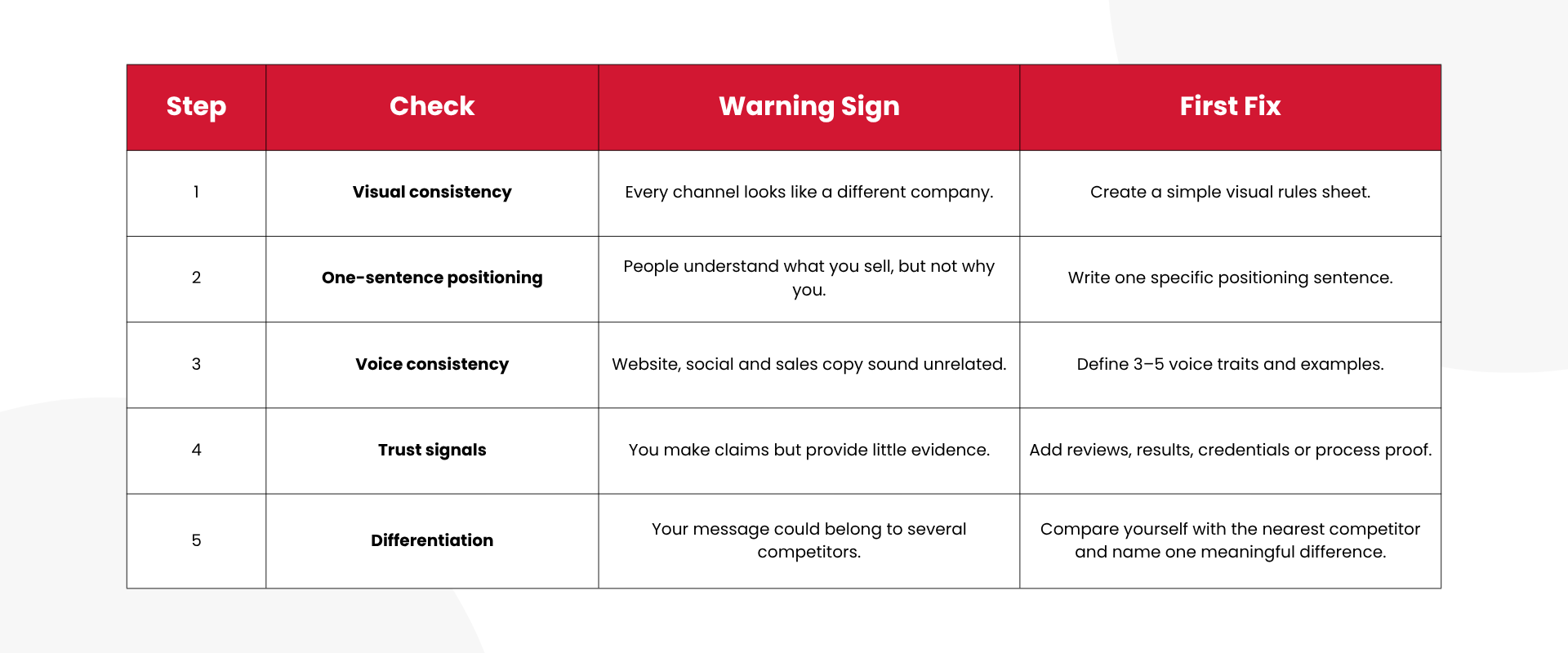
Voice examples: Clear → short, direct explanations; avoid unnecessary jargon. Confident → specific claims supported by evidence; avoid empty superlatives. Warm → human, helpful language; avoid overly corporate phrasing.
What If All Five Checks Reveal Problems?
That still does not automatically mean “rebrand everything.” Fix in layers. Start with the issue most likely to create confusion, usually positioning or inconsistent messaging. Then bring the visual system and voice into alignment. Add stronger proof. Finally, refine the areas where you genuinely lack differentiation.
This is often more practical for a small business than treating branding as a single, expensive event. You can improve the system while keeping the assets that already work.
A 30-Minute Brand Clarity Audit You Can Do This Week
- Open your website, social profile, proposal and sales deck side by side.
- Write your current one-sentence description of the business.
- Ask someone outside the business to describe what they do after looking at your homepage for 20 seconds.
- Circle the three claims you make most often. Find the proof supporting each one.
- Choose your closest competitor and complete the comparison table above.
- Write down the one thing you want a prospect to remember after the first interaction.
- Pick one fix you can implement this week without changing your logo.
When a Redesign Actually Makes Sense
A full redesign can be appropriate when the existing identity no longer reflects the business, has serious usability problems, is difficult to apply consistently, or the business has materially changed its market position. But those are diagnostic conclusions, not starting assumptions.
If your core offer is sound and the existing visual identity is usable, a focused brand cleanup may solve more of the problem than replacing everything. The goal is not to make the brand look newer. It is to make the business easier to recognise, understand and trust.
Need a Second Pair of Eyes?
If you know something about your brand is not landing but cannot pinpoint what it is, start with the five checks in this guide. If you would rather have an outside team identify the gaps, Gyaata offers a free 30-minute brand clarity session to look at what is—and isn’t—working across your positioning, visual identity, voice and customer-facing presence.

FAQs
1. How can a branding agency for small business make my brand more memorable?
A branding agency for small business can identify what is making your brand feel inconsistent or unclear and fix those issues without necessarily requiring a complete rebrand. This may include refining your brand positioning, visual identity, brand voice, messaging, and customer touchpoints. The goal is to create a brand that is consistent, recognisable, and clearly communicates why customers should choose you.
2. Does small business branding require a complete rebrand?
No. Small business branding does not always require a complete redesign. Often, the problem is a lack of consistency, unclear positioning, weak messaging, or an inconsistent brand voice. A focused brand refresh can address these issues while keeping the elements of your existing brand that are already working. A structured brand audit can help determine whether you need a refresh or a full rebrand.
3. What is brand positioning, and why does it matter for a small business?
Brand positioning defines how you want your business to be understood in the minds of your target customers compared with competitors. Clear brand positioning helps customers quickly understand what you offer, who you serve, and what makes your business different. Without it, even a visually attractive brand can feel generic or forgettable. Strong positioning gives your content, messaging, and marketing a clearer direction.
4. How does brand consistency help create a memorable brand?
Brand consistency means presenting the same core identity across your website, social media, advertising, content, sales materials, and customer communications. Consistent colours, visuals, messaging, tone of voice, and positioning make it easier for customers to recognise and remember your business. For small businesses, improving consistency can be one of the simplest ways to strengthen brand identity without investing in an expensive redesign.
5. How can I improve my brand identity without spending on a full redesign?
Start with a brand clarity audit. Review five areas: visual consistency, positioning, brand voice, trust signals, and differentiation. Identify the areas creating the biggest disconnect and fix those first. You may need clearer messaging, a more consistent visual system, stronger proof points, or a more distinctive tone rather than an entirely new logo or website. This approach allows small businesses to improve their brand identity strategically and within budget.