
A potential customer opens ChatGPT and types, “Who is the best electrician near me for an emergency repair?” Within seconds, they get a short list of names, a few reasons, and a handful of sources. They may never open Google at all.
If your business is not in that answer, you are invisible to a growing group of buyers. This guide explains how to show up in ChatGPT and Perplexity, using a practical approach called generative engine optimization (GEO) built for local service businesses.
Why AI Answers Are the New First Page for Local Businesses
For years, local visibility meant ranking in the map pack and the top ten blue links. That still matters, but people now also ask AI tools for recommendations, comparisons and how-to advice. These tools give one synthesised answer instead of a page of links, which means fewer businesses get mentioned and the ones that do, win far more attention.
For service businesses such as clinics, home-service companies, salons, accountants and contractors, this is a real opportunity. AI tools are trying to answer specific, high-intent questions, and a small business with clear, trustworthy information can compete with much larger brands.
What Is Generative Engine Optimization (GEO)?
Generative engine optimization is the practice of making your business easy for AI tools to find, understand, trust and cite. Where traditional SEO aims to rank a page, GEO aims to get your brand named inside the answer itself.
The two overlap heavily. Good content, a solid website, local signals and strong reviews help in both. The difference is emphasis: AI search optimization for local businesses rewards clarity, consistency and proof over keyword tricks. Nobody can guarantee a citation, but you can raise your odds considerably.
How ChatGPT and Perplexity Decide Who to Mention
Both tools pull from a mix of what they already know and what they retrieve from the live web. In practice, they favour sources that are:
- Accessible: their crawlers are allowed to read your pages.
- Specific: the page directly answers the question being asked.
- Consistent: your name, address, services and details match across the web.
- Credible: reviews, mentions and third-party sources back up your claims.
Perplexity is especially transparent about this, showing sources alongside its answers, which makes it a useful place to learn what earns citations in your industry. Keep that in mind as you work through the steps below.
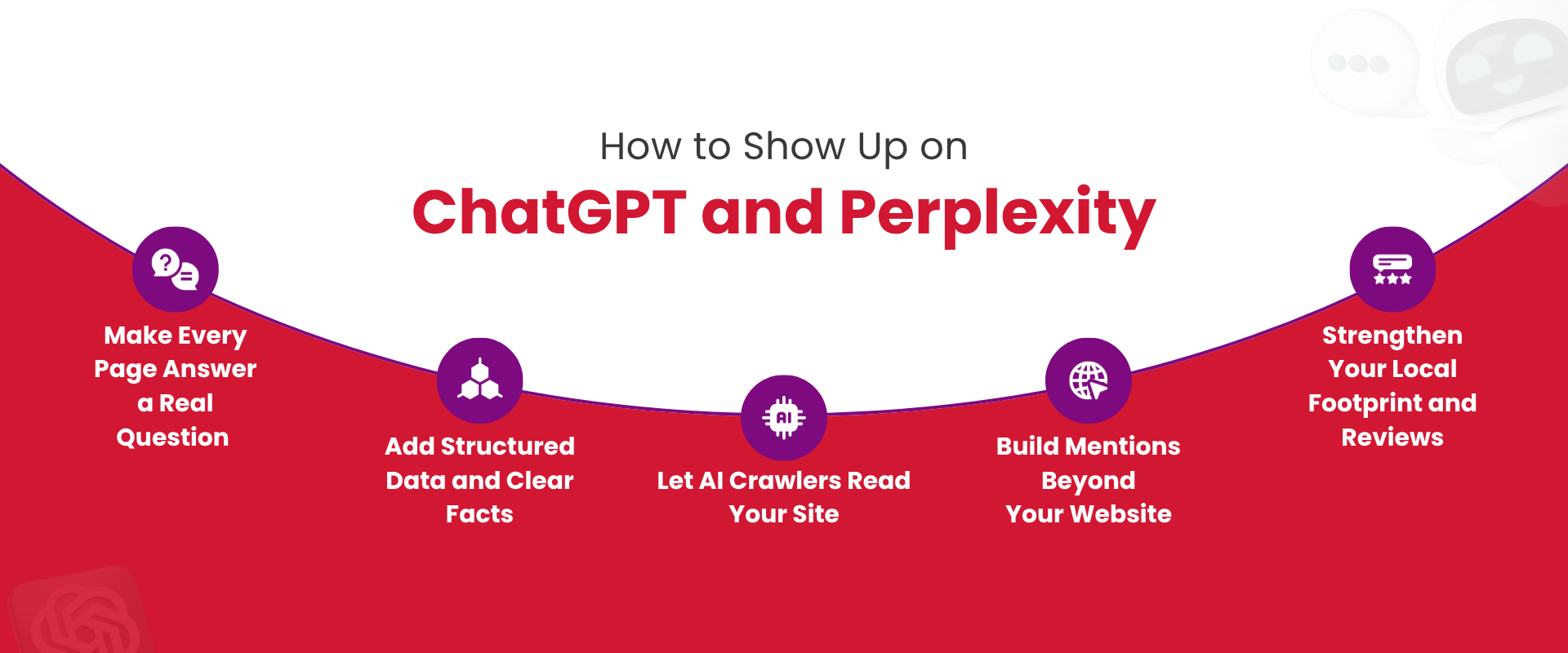
Step 1: Make Every Page Answer a Real Question
AI tools quote pages that answer questions plainly. Review your service pages and ask: could someone lift a clear, accurate answer straight from this page?
- Lead with the answer. Put a one or two sentence summary near the top of every page, then add detail below.
- Use real questions as headings. “How much does a boiler service cost?” beats “Our Pricing.”
- Be specific. Name your services, service areas, hours, price ranges and typical timelines.
- Add an FAQ section. Short, direct answers to the questions customers actually ask on the phone are ideal.
- Show experience. Mention years in business, certifications, team credentials and the types of jobs you handle.
This is also where strong content pays off beyond AI. Pages that answer questions well tend to convert better with human visitors too.
Step 2: Add Structured Data and Clear Facts
Structured data, often called schema markup, is a way of labelling your content so machines can read it without guessing. For a local business, the most useful types include LocalBusiness, Service, FAQPage and Review markup.
Alongside schema, keep a clear “about” page and a “services” page that state the basics in plain language: who you are, what you do, where you work, how to contact you and why customers trust you. AI tools are far more likely to describe you accurately when the facts are easy to find and do not contradict each other.
Step 3: Let AI Crawlers Read Your Site
The simplest fix is also the most commonly missed. If your robots.txt file or firewall blocks AI crawlers, they cannot read your content, and you cannot be cited from it.
OpenAI uses separate crawlers for different jobs. OAI-SearchBot is used to surface websites in ChatGPT’s search features, and OpenAI recommends allowing it in your robots.txt file. GPTBot is a separate setting, so you can allow search visibility while disallowing training use if you prefer. You can read the details in OpenAI’s crawler documentation. Changes can take around 24 hours to take effect.
For Perplexity, PerplexityBot is designed to surface and link websites in its search results, and Perplexity recommends allowing it in robots.txt. See Perplexity’s bot documentation for the current guidance.
Also check that your site loads quickly, works on mobile and does not hide key information behind pop-ups or logins. If a crawler cannot read it, an AI tool cannot quote it.
Step 4: Build Mentions Beyond Your Website
AI tools do not rely on a single source. They look for corroboration. To get cited by Perplexity and ChatGPT, your brand should appear in more places than your own site.
- Local press and community sites: sponsor an event, share an expert quote or contribute a useful guide.
- Industry associations and partner websites: member listings and partner pages add credibility.
- Customer stories and case studies: publish results with permission, and share them where your audience reads.
Helpful community answers: thoughtful, honest contributions on forums and Q&A sites can reinforce your expertise, as long as they are genuine and not promotional spam.
Step 5: Strengthen Your Local Footprint and Reviews
Local service businesses have an advantage: a lot of trusted signals already exist outside their website. Make them work for you.
- Claim and complete your Google Business Profile. Fill in services, categories, hours, photos and descriptions.
- Keep your details consistent. Your business name, address and phone number should be identical on your website, directories and social profiles.
- Collect reviews steadily. Ask happy customers for reviews on the platforms your audience uses, and reply to them. Reviews that mention specific services and locations are especially useful.
- List yourself in relevant directories. Industry and local directories act as supporting evidence that you exist and do what you say.
If you want help building these into a repeatable system, our digital marketing services cover local visibility, reviews and reputation.
How to Check Whether You Are Being Cited
You do not need expensive tools to start. Build a list of ten to twenty questions your customers would realistically ask, such as “best [service] in [city]” or “how much does [service] cost.” Then:
- Ask each question in ChatGPT and Perplexity.
- Note whether your business is mentioned, and which sources are cited.
- Repeat the same check every month and record the changes.
Pay special attention to the sources Perplexity shows. They reveal which directories, review sites and articles are shaping answers in your industry, which tells you where to build presence next. Results can vary between sessions, so look for patterns rather than single results.
Common Mistakes to Avoid
- Blocking AI crawlers by accident, often through a security plugin or a blanket robots.txt rule.
- Writing vague pages that never state prices, areas or specifics.
- Inconsistent business details across directories and social profiles.
- Ignoring reviews, or leaving them unanswered.
- Chasing shortcuts. Stuffing keywords or publishing thin, AI-generated pages rarely earns trust from people or from AI tools.
- Expecting overnight results. GEO compounds over weeks and months, the same way strong SEO does.
Start with a Clear Picture of Where You Stand
The businesses that get recommended by AI are rarely the loudest. They are the clearest, the most consistent and the best supported by proof. Start with the basics: let crawlers in, answer real questions, tighten your local signals and earn mentions.

Or talk to our team about building a GEO plan for your business.
Frequently Asked Questions
1. How long does it take to show up in ChatGPT or Perplexity?
It varies by industry, competition and how much work your site needs. Technical fixes can take effect within days, but building the reviews, content and mentions that earn citations usually takes a few months of steady effort.
2. Is GEO different from SEO?
They share the same foundations, but GEO focuses on being cited inside AI-generated answers. Strong SEO helps, and GEO adds an emphasis on clear answers, structured facts and corroboration from other sources.
3. Can I pay to be recommended by ChatGPT or Perplexity?
You cannot buy a place in an organic AI answer. The reliable route is earning it through accessible, trustworthy, well-supported content and a strong local presence.
4. Do small local businesses really have a chance?
Yes. AI tools respond to specific questions, so a local business with detailed, accurate pages and strong reviews can be a better answer than a large generic brand.
5. Should I allow all AI crawlers on my site?
That is your decision. If your goal is to be cited in AI search, allowing the search crawlers from OpenAI and Perplexity is the practical starting point, and you can treat training crawlers separately.